





近日,食品与生物工程学院食品营养与安全团队李军老师在食品领域TOP期刊《Food Chemistry》(Q1,IF: 9.8)发表题为“Fluorescence/colorimetric intelligent sensor based on Fe-adsorbing carbon dots nanozymes for selective recognition and quantification of total antioxidant capacity in foods and cells”的研究论文。李军老师为论文第一作者,食品与生物工程学院研究生李艳丽为共同第一作者,理学院周倩副教授和王周玉教授为本文的通讯作者。
论文截图
不断升级的氧化应激极大地增加了日需要量,总抗氧化能力(TAC)已成为重要的指标。因此,开发有效的TAC评价方法一直是研究热点。本文通过合理设计构建了一种基于Fe-CDs的荧光/比色传感器。基于铁吸附的策略将碳点的荧光猝灭,并通过添加抗氧化剂使其恢复,从而实现荧光检测。此外,该策略还赋予了Fe-CDs实现比色检测所必需的过氧化物酶(POD)活性。随后,作者构建了一种基于Fe-CDs的双模荧光/比色传感器阵列,对7种抗氧化剂进行了选择性识别,并对5种实际样品的TAC进行了准确评价。此外,Fe-CDs荧光/比色法检测果汁中抗坏血酸TAC具有良好的准确性和抗干扰性,检出限分别为2.1 μM和0.4 μM,线性范围分别为4 ~ 40 μM和6.3 ~ 150 μM。此外,Fe-CDs还可以通过荧光成像引导了细胞水平的谷胱甘肽含量的变化。
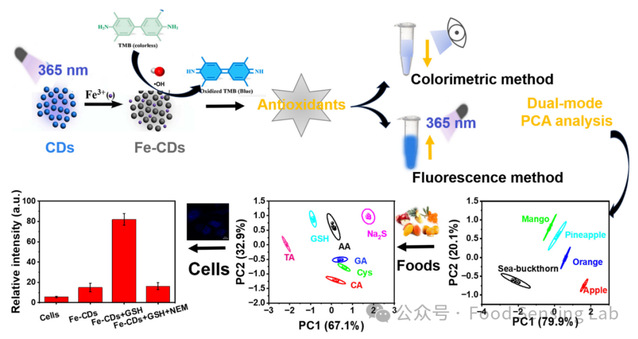
Scheme 1. Schematic diagram of fluorescence/colorimetric intelligent sensor based on Fe-adsorbing carbon dots nanozymes for sensitive and selective recognition and quantification of TAC in fruits and cells.
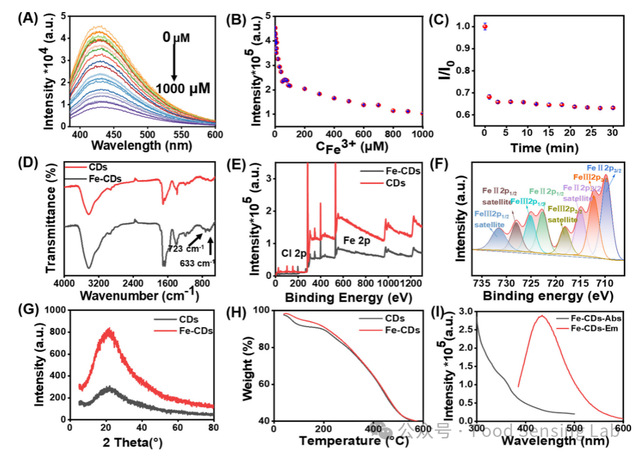
Fig. 1. (A) Fluorescence spectra, and maximum emission intensity at 429 nm of CDs in the presence of (B) different concentrations and (C) reaction time of Fe ion, (D) FTIR spectrum, (E) XPS spectrum, (F) Fe 2p spectrum in XPS of Fe-CDs, (G) XRD pattern and (H) TGA thermogravimetric curve of CDs and Fe-CDs and (I) UV absorption /fluorescence emission spectrum of Fe-CDs.
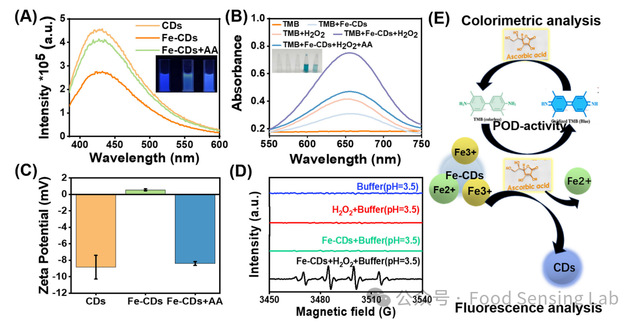
Fig. 2. (A) Fluorescence enhancement curve and (C) Zeta potential of Fe-CDs before and after adding AA, (B) UV–vis absorption spectrum in oxTMB system of Fe-CDs before and after adding AA, (D) ESR spectrum of Fe-CDs under different condition, and (E) Schematic diagram of the mechanism of Fe-CDs for detecting antioxidants through fluorescence/colorimetric analysis, respectively. Inset was the corresponding photographs.
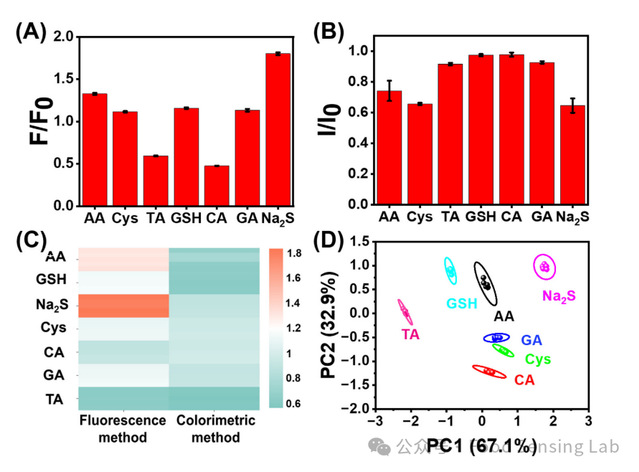
Fig. 3. (A) Fluorescence (ΔF) response patterns, (B) Colorimetric (ΔI) response patterns, (C) Heat map obtained from ΔF and ΔI and (D) 2D canonical score plots for ΔF and ΔI of sensor array developed by Fe-CDs toward 7 antioxidants. F, I and F0, I0 represent the fluorescence intensity or UV intensity of Fe-CDs in the presence and absence of antioxidants, respectively
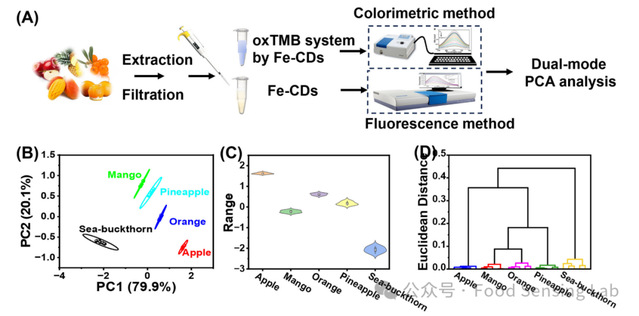
Fig. 4. (A) Schematics of TAC recognition of various fruit juice based on fluorescence/colorimetric sensor array. (B) 2D canonical score plots of the sensor array toward 5 fruit juice samples. (C) Plot of the PC1 and (D) SCA dendrogram vs 5 fruit juice samples, respectively.
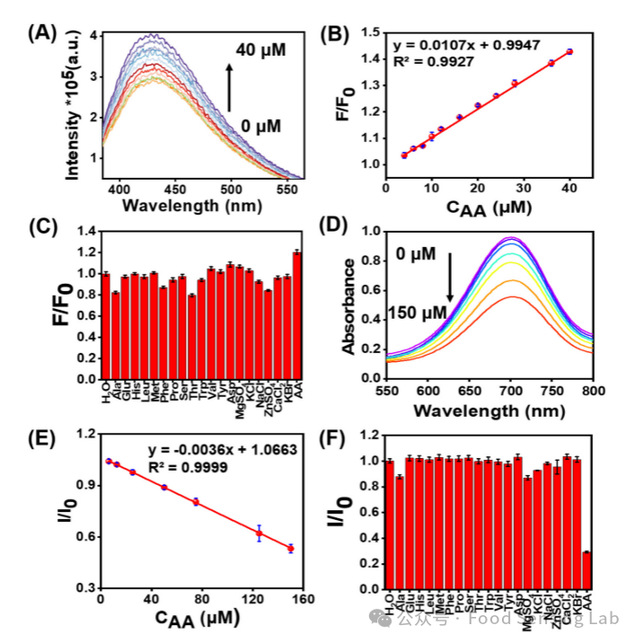
Fig. 5. (A, D) Fluorescence and UV–vis absorption spectrum of fluorescence and colorimetric intelligent sensor after adding AA, (B, E) Calibration linear curve of ΔF and ΔI versus AA concentration, and (C, F) Selectivity investigation of ΔF and ΔI under interfering amino acid and ions.
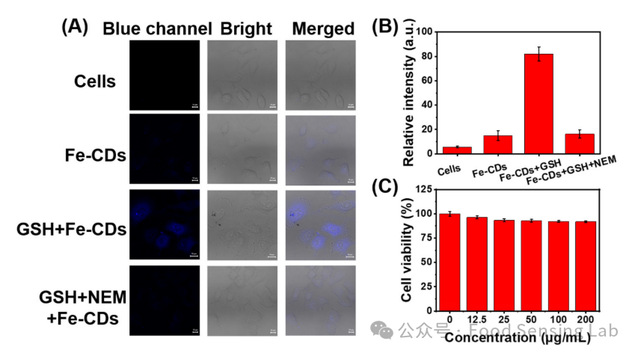
Fig. 6. (A) CLSM images, and (B) Relative fluorescence intensity of cells treated with Fe-CDs under conditions of additional or depletion of GSH. (C) Cell viability of HL-7702 cells treated with Fe-CDs. The scale bar was 10 μm.
这项工作构建了一个基于Fe-CDs碳点纳米酶的荧光/比色智能传感器。合理设计的Fe-CDs既保持了CDs的荧光性能,又赋予其纳米酶活性。随后,成功开发了一种灵敏、选择性的双模传感器阵列,用于识别7种抗氧化剂(AA、Cys、TA、GSH、CA、GA和Na2S)。Fe-CDs通过自荧光响应抗氧化剂,并表现出优异的TMB氧化催化活性。由于抗氧化剂的还原能力不同,两个独立的传感器单元对抗氧化剂表现出独特的荧光/比色响应。荧光/比色传感器阵列已成功地用于TAC评价,以鉴定各种水果(沙棘、苹果、芒果、菠萝和橙子)。更重要的是,Fe-CDs已成功地用于实际食物和细胞中AA TAC或GSH的定性和定量检测。综上所述,基于铁吸附策略合理地开发了一种碳点纳米酶,其具有良好的荧光/比色传感能力。这项工作不仅为多功能纳米酶的合理设计提供了有价值的见解,而且还展示了它们在食品/生物分析领域的巨大实际应用潜力。